
Were you injured in a barge accident in St. Louis, MO?
At Goldstein and Price, L.C., we are trusted barge injury lawyers with over 60 years of experience.
If you were hurt while working aboard a barge on the Mississippi River, federal maritime law usually controls your claim instead of Missouri workers’ compensation. A St. Louis, MO barge injury lawyer can identify which maritime remedies apply and which companies are legally responsible for the accident.
Our attorneys are admitted in Missouri and Illinois. We have tried river injury cases in both state and federal courts. We examine vessel records and crew accounts before advising a client on a claim’s value. Contact our firm to have a barge injury attorney review the facts of your accident.
Barge Injury Lawyer St. Louis, MO
A barge injury attorney in St. Louis represents deckhands, tankermen, and fleet workers who are hurt on or around barges and towboats. These cases proceed under federal maritime law. Many river workers are excluded from state workers’ compensation and must pursue a maritime claim against the employer or vessel owner instead. A lawyer handling these claims identifies the correct remedy and gathers the records that support it.
Marine transportation workers died on the job at a rate of 18.4 per 100,000 workers from 2011 to 2017, according to NIOSH fatality data. That rate is nearly six times the rate for all U.S. workers. Fleeting, loading, and towing operations along the St. Louis riverfront carry the same risks, and the employer’s records usually show what went wrong.
Types of Barge Injury Cases We Handle in St. Louis, MO
Barge injury claims vary with the worker’s job, the location of the accident, and the company that controlled the vessel. Our firm handles the following categories of injury claims in the St. Louis harbor and on the nearby rivers.
- Deck falls. Barge decks are often wet or icy, and grain dust can make the surface slick. Hatch covers and coamings also create trip hazards. We examine deck conditions and maintenance records to determine whether the employer should have corrected the hazard before the fall.
- Line handling and rigging injuries. Deckhands work with heavy lines while making up tows and securing barges in fleets. A line that parts under tension can break bones or cause amputations. We review the condition of the lines and the instructions the crew received that day.
- Towboat injuries. Towboat crews face engine room hazards, steep stairways, and the physical strain of building and breaking tows. These injuries often involve the same employer and the same federal remedies as injuries on the barge itself.
- Jones Act claims. A crew member who qualifies as a seaman may bring a negligence claim against the employer under federal law. The claim depends on proof that the employer’s carelessness played some part in causing the injury.
- Lock and dam injuries. Barge tows pass through locks on the upper Mississippi River with little room to spare and heavy lines under load. Crew members can be crushed between barges and lock walls or struck when a line fails.
- Longshore claims. Workers who load and unload barges at terminals often fall outside the Jones Act. A separate federal compensation program covers many of these workers, and a negligence claim against the vessel owner may also be available.
- Maintenance and cure. An injured seaman is generally entitled to daily living support and medical care until reaching maximum medical improvement. We pursue these benefits when an employer underpays them or cuts them off early.
- Chemical and cargo exposure. Tank barges carry petroleum products and industrial chemicals. Exposure during loading, cleaning, or transfer operations can cause burns and lasting respiratory injuries.
- Wrongful death claims. When a barge accident is fatal, the worker’s personal representative may pursue damages on behalf of the family. We investigate these accidents with the same attention to vessel records and witness accounts that we give to every injury claim.
Why Choose Goldstein and Price, L.C. as my Barge Injury Lawyer in St. Louis, MO?
Six Decades of Admiralty Practice on the Inland Rivers
Our firm has concentrated on admiralty and maritime law for more than 60 years. Our attorneys have tried maritime cases in courts throughout the inland river system. Barge injury suits in this region can proceed in state or federal court on either side of the Mississippi River. Our attorneys are licensed in both Missouri and Illinois, which allows us to follow a claim wherever it is properly filed. Goldstein and Price, L.C. brings that depth of river litigation to its role as a personal injury lawyer in St. Louis, MO. A St. Louis barge injury attorney with this background understands how tows are assembled and how fleets operate day to day.
Neal W. Settergren’s Background in Towage and Admiralty Law
Neal W. Settergren has represented clients in the maritime industry for more than 20 years. He co-authored “An Update on the Troubled Waters of Towage Law,” which the Tulane Law Review published in 2005. From 2007 to 2016, he taught admiralty and maritime law as an adjunct professor at Saint Louis University School of Law. Neal earned his J.D. at Washington University School of Law, where he was named to the Order of the Coif and served as an articles editor of the law review. He also graduated summa cum laude from Drake University, where he was elected to Phi Beta Kappa. He is licensed to practice in Missouri and Illinois.
St. Louis Barge Injury Infographic
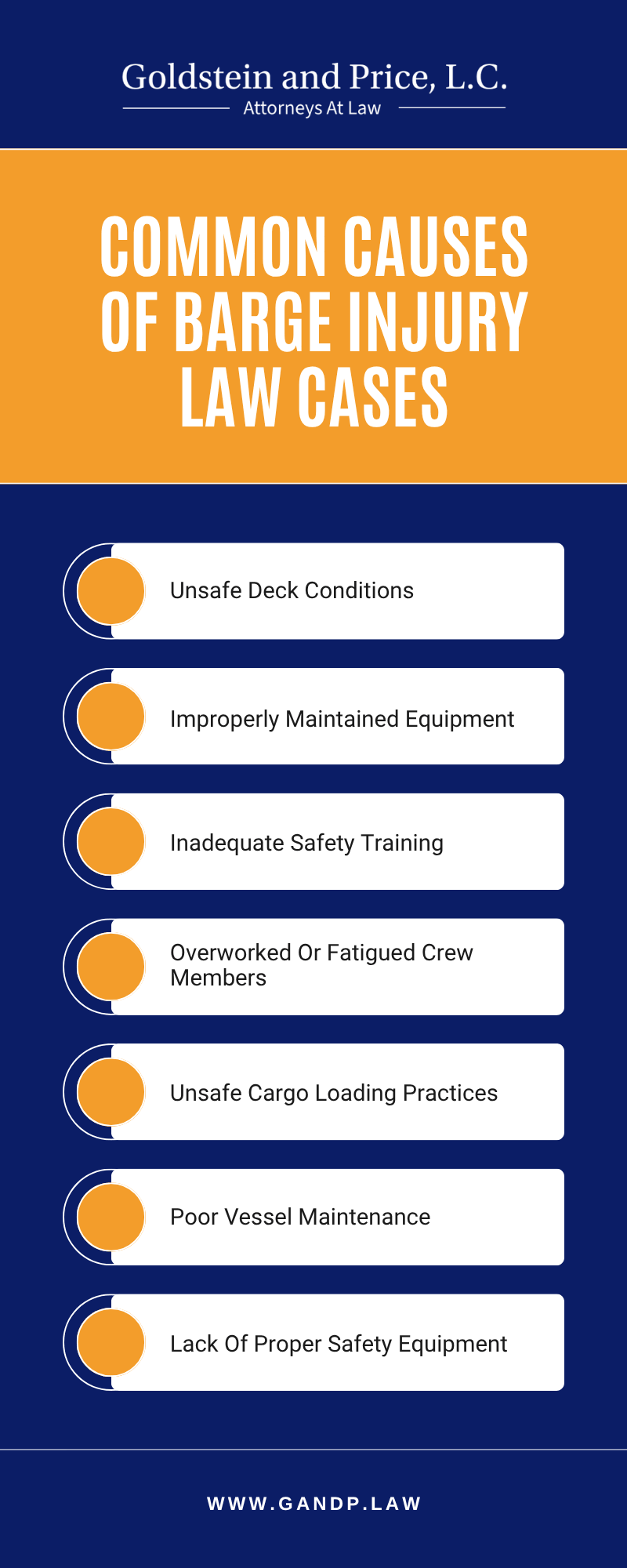
Understanding Barge Injury Cases
Damages, Liability, and Compensation for Barge Injury Cases
A barge injury claim requires proof of fault and proof of loss. Under the Jones Act, a seaman injured in the course of employment may sue the employer and have the case decided by a jury. Other parties can share responsibility as well. A towboat operator, a fleeting company, or a terminal owner may also be liable when its negligence contributed to the accident. Claims against those companies proceed separately from the claim against the employer, and they can increase the total recovery.
Damages in a maritime injury claim generally fall into these categories:
- Lost wages cover the paychecks missed during recovery and the earning capacity the injury takes away.
- Medical damages include hospital bills, surgery, and the cost of future care.
- Pain and suffering damages compensate for the physical and emotional toll of the injury.
- Disability and disfigurement damages apply when an injury leaves permanent limitations or scarring.
Fault can be divided between the worker and the employer. A worker’s own share of fault reduces the award, but it does not bar the claim. Maintenance and cure is a separate benefit, and an employer owes it regardless of who caused the accident. A barge accident lawyer in St. Louis will account for each of these remedies before any settlement figure is discussed.
What Are Important Aspects of a Barge Injury Case?
Several issues decide the strength of a barge injury claim early in the case. Each one affects which remedies are available and how quickly the claim must move.
- A worker must qualify as a seaman to bring a Jones Act claim. Courts consider the worker’s duties and the time spent aboard vessels.
- Most maritime injury claims must be filed within three years of the injury. A Missouri injury claim that falls outside maritime law generally carries a five-year limit.
- Deck logs, crew statements, and maintenance records can show what the company knew before the accident.
- Consistent treatment records connect the injury to the accident and support the claim for future care.
- Prompt notice of the injury to the employer creates a record that the accident happened on the job.
What Is The Barge Injury Case Timeline?
Most barge injury cases follow a similar sequence, although the length of each stage varies. Cases involving permanent injuries or disputed fault usually take longer to resolve.
- Medical treatment begins, and maintenance and cure payments should start while the seaman recovers.
- We gather vessel logs, photographs, and statements from the crew members who saw the accident.
- A claim or lawsuit is filed before the filing deadline expires.
- Both sides exchange documents and take sworn depositions during discovery.
- The parties negotiate, and the case proceeds to trial if no fair offer is made.
Our St. Louis barge injury lawyers prepare each claim for trial from the beginning. Thorough preparation strengthens a client’s position during settlement negotiations as well. A settlement reached before the full extent of the injury is known can leave future medical costs uncovered.
What Should You Bring to Your Barge Injury Consultation?
Documents about your job and your injury allow us to evaluate the claim at the first meeting. Please gather as many of the following as you can.
- Pay stubs and W-2 forms show who employed you and how much time you spent working aboard vessels.
- Your copy of the employer’s accident report, or your own written account, records the details of the incident.
- Medical records and bills show the extent of the injury and the treatment you have received.
- Records of maintenance and cure payments show what your employer has paid since the injury.
During the consultation, a barge injury attorney reviews these documents with you and explains which maritime remedies apply to your situation. When a towboat or terminal company shares responsibility with the employer, we explain how those claims fit together. You will receive a direct assessment of whether the claim is worth pursuing.
Reach Out to Goldstein and Price, L.C. to Schedule a Consultation
An injury on a barge raises questions about federal law, employer obligations, and the filing deadline. Our St. Louis, MO barge accident attorney can answer those questions after reviewing how the accident happened. Contact us to arrange a consultation about your barge injury claim and the maritime remedies that apply to it. We are available to discuss your claim when you are ready.